Nairobi residents lead the pack in terms of unsafe food consumption and according to Heinrich Boll Stiftung, they consume 44.4 percent of unsafe vegetables that are being supplied to the capital’s open-air markets. Killer pesticides in Kenya
A group of youth known as Cute Garden at Kamae, Kahawa west ward in Kiambu County are championing for food security and safety, besides embracing a modern farming method known as Vertical Indoor farming which uses UVA lights to grow vegetables.
As you approach the garden which is located in a neighborhood that is notorious for crime and alcoholism, the eyes are attracted to different colors applied outside the garden resonating with their name ‘Cute.’
Outside I met Gabriel Mauna, 34, the founder of this group, who is busy assigning members key responsibilities. Among the youths assigned were previously involved in violent crime and substance abuse.
Even before he finishes assigning his peers duties for the day, Mauna extends his welcome to me with a bunch of Sukuma wiki(kale) and spinach.
“I am happy my team reduced alcohol consumption and theft, hence diverting their energy to the farm. Our aim here is to ensure we have enough and safe vegetables for consumption by our families and customers,” said Mr. Mauna.
According to Mauna, five years ago the area was very unsafe and residents have now returned to their houses when the situation has appeared calm.
“Engaging youth has enabled us to improve the environment and ensure that such incidents are reduced,” added Mauna.
The group acquired the land that previously used to operate as a bar from one of the landlords, promising to pay 2000 Kenya shillings per month. The size of a land being equivalent to that can be used to build three aluminum houses, with the intention of growing vegetables in a safe environment.
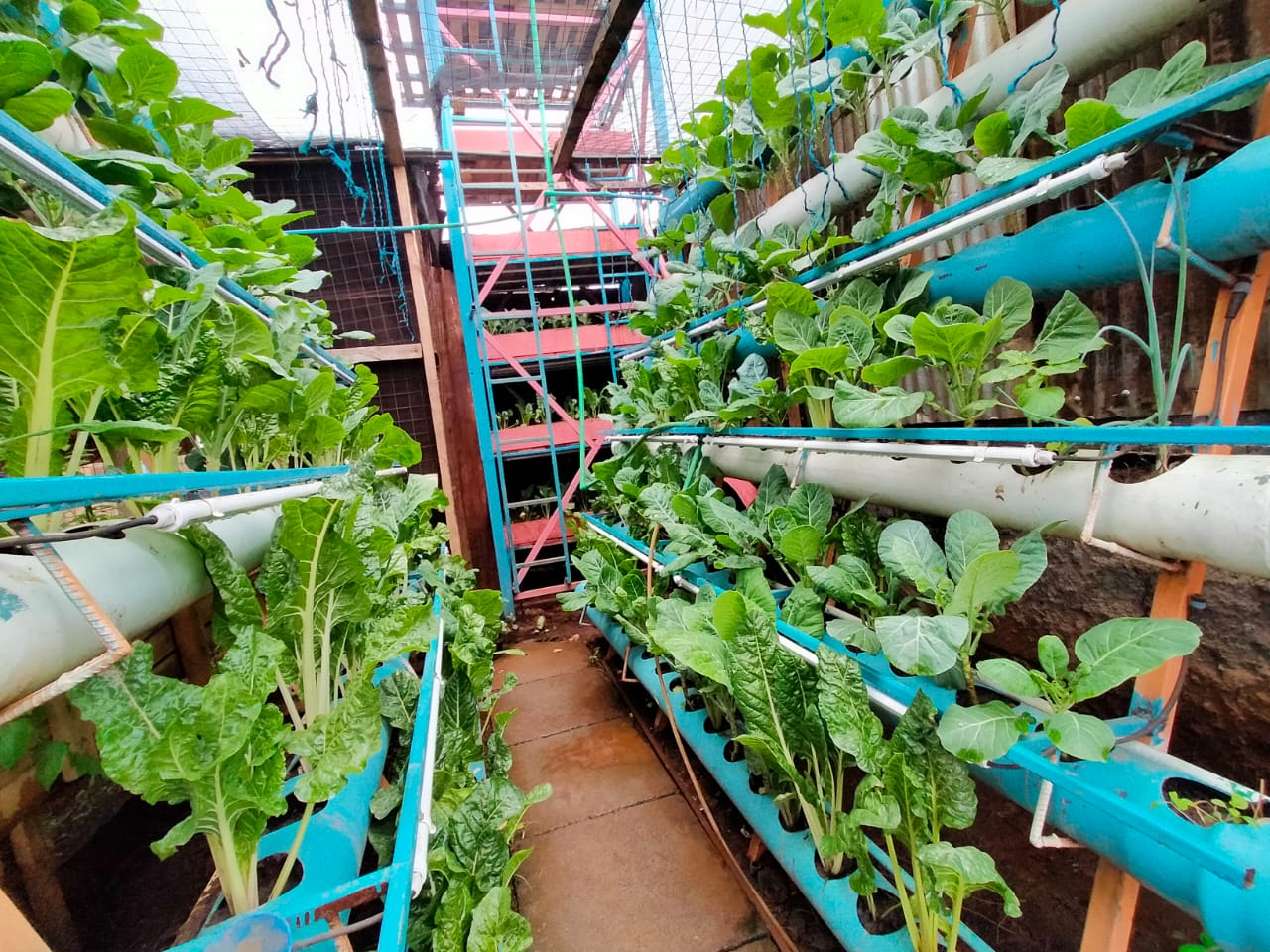
Inside the farming area, you can see kales, spinach, onions planted inside a pipe that holds the soil. The pipes are arranged in layers, some connected with UVA bulbs.
The farm utilizes lighting from the bulbs at night due to the challenge of shadows, which hinder the plants from thriving.
“The lower parts are affected by the shade. Our innovation is to use artificial lighting. We use UVA bulbs to help these plants get light. This shadow is caused by the wall of the house, so when we noticed our plants were affected, we ordered these bulbs from China,” explained Mr. Mauna.
The demand from customers helped them to come up with an idea to use artificial light and boost yields.
“When a customer orders the stock in large quantities, that is the time we realize we cannot harvest the upper part to satisfy him or her. You find that the lower side of the vegetables could wither,” added Mr. Mauna.
Kelvin Akumu Mugai, 33, who acts as farm assistant urged Nairobi residents not to underestimate the small size of land they occupy.
He said depending on the size of the land, a farmer can harvest vegetables equivalent to half an acre once they embrace innovation.
“When you tell them to farm, they ask you, where and how? The notion of having a large farm is outdated,” said Mr. Akumu.
“You don’t need ten acres, hoes, and machetes to farm. Vertical Garden farming for urban farmers needs a space that can hold a few pipes with a length of a meter. You can plant between 19 to 30 plants. One side of the vegetables is equivalent to a quarter acre,” said Mr. Akumu.
He acknowledged that vertical garden farming is very sustainable more so since it leverages organic methods to contain pests that damage crops.
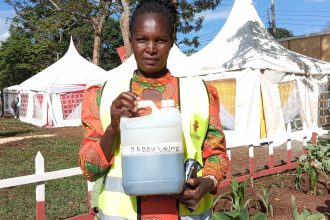
“We don’t use chemicals from the store. If these plants reach a point where they need a pesticide, we use rabbit urine, which is beneficial to us. Or we use garlic and chili water. As for fertilizer, we use kitchen waste such as onion, vegetables, and animal manure,” Akumu explained.
Despite having its own set of challenges, the cute garden youth have found respite in vertical gardens. Akumu said water scarcity has been a perennial challenge since they receive the commodity from the city utility twice a week.
“The water shortage has been an issue to us, forcing us to install small tanks to ensure our plants continue to thrive. Our preference is to see the community embracing this farming, but it has been contrary to our expectations,” added Akumu.
The youth group’s vision is to uplift and enhance skills for communities living in slums that have small farms, applying agricultural innovations that have worked magic in countries like Israel and Egypt.
“This farming is costly, especially during security measures. Slum areas facing theft will have to install CCTV cameras like we have here to monitor who entered and harvested vegetables without our permission,” said Akumu.
Our plants stay here overnight without being stolen, and many of the young people who were thieves have reformed and are now guards,” he added.
With enthusiasm for modern farming, the youth hope to expand the farm and grow crops on a larger scale.
“This area is not very large; we hope to acquire a 50 by 100 plot so that we don’t have to worry about where to place the machines we use for drilling these trenches,” concluded Akumu.
Mauna believes that by eating safe food and being aware of how they are grown, only few people would be seeking medical attention in hospitals after contracting ailments linked to consumption of contaminated food.
“Nairobi city is greatly affected by lack of knowledge about the source of vegetables consumed by residents. You find people eating vegetables whose source is questionable,” said Mauna.