The Eastern Branch Agricultural Show held in Embu County from 14th-16th March 2024, was one of its kind as all the stakeholders in the sector gathered to showcase the latest technologies in agriculture.
The agriculture sector has been greatly hit by the effects of climate change which has left farmers counting double losses due to prolonged droughts and now to floods from the ongoing high rainfall.
The Embu Agricultural Show brought together school going pupils, farmers’ groups, experts, government and non-government officials and all the stakeholders in the agriculture value chain
In line with this year’s theme, “Promoting Climate Smart Agriculture and Trade Initiatives for Sustainable Economic Growth.” The farmers were eager and ready to learn as they could be seen writing down notes while others took photos of the technologies presented at the show.
Out of the many stands at the show, one notable stand that received overwhelming visitors was the compost manure making stand that showcased how farmers can utilize the locally grown plants to make their own compost manure that is rich in proteins for their plants.
Samwel Mwangangi, an outreach officer at Caritas Embu community based integrated rural development project took the farmers in all the steps required for making the compost manure. Mwangangi shares that as a community-based organization they ran initiatives that target resource poor household farmers with initiatives that help them improve their livelihood.
“Soil fertility has been a challenge to most of our farmers due to excessive use of fertilizers that are high in chemicals, we analyze and teach farmers on how they can improve their soil fertility and we use compost manure because it uses the available materials,” says Mwangangi.
He adds that a farmer can use trees, vegetables that are in excess from their farms to make their own compost manure. According to him, there are three different methods of preparing the compost manure. “We have the hip method, the pit method and the trench method,” he shares.
Mwangangi reiterates that the compost manure making is simple and it lasts long as compared to the ones bought in shops.
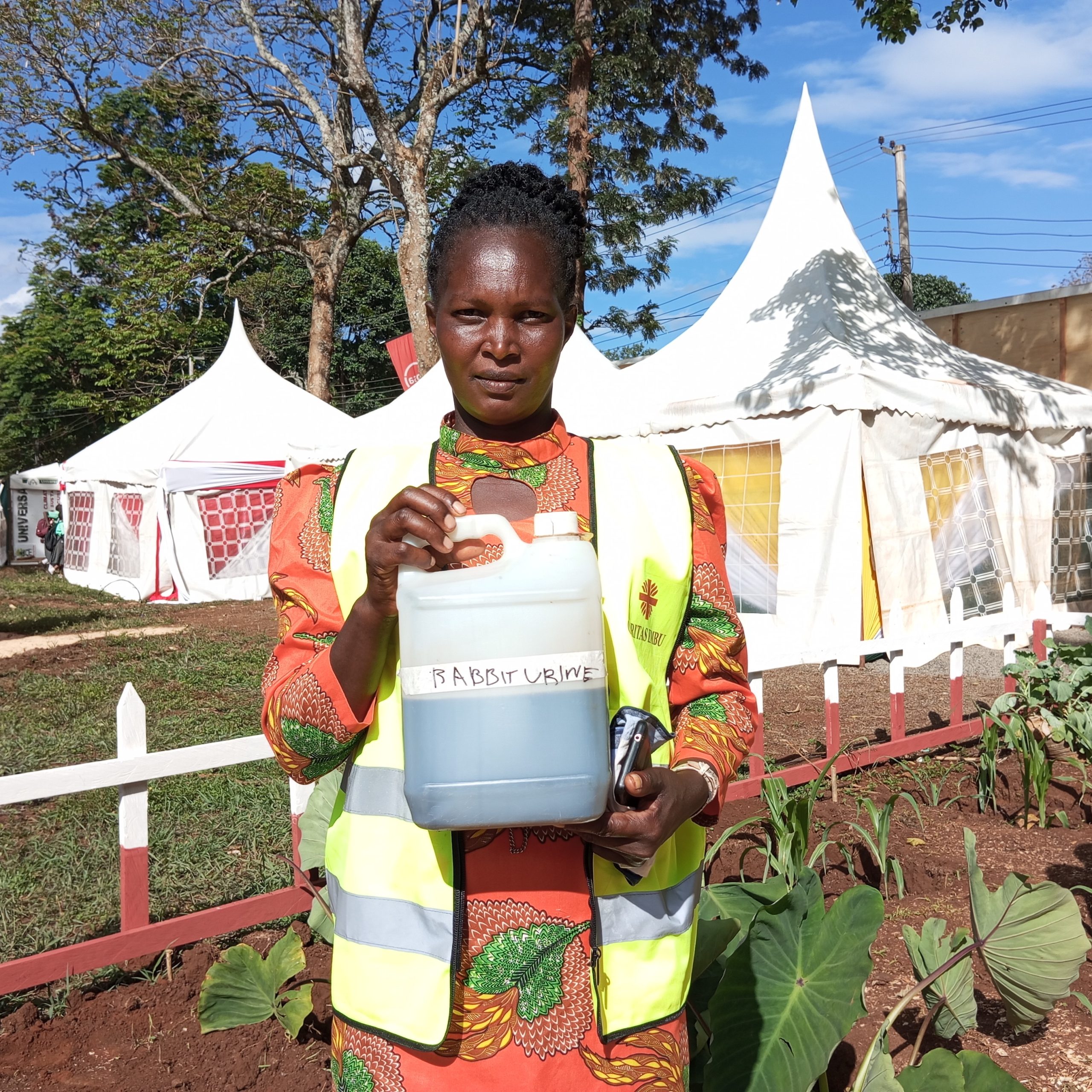
Another notable stand during the show was the one on the use of rabbit urine as an organic fertilizer and as a pesticide. Anaciah Nyaga has been practicing the use of rabbit urine in her kitchen garden farm and she says that she will never look back.
“Since 2016, I have been practicing organic farming in my small kitchen garden and so far, I can say that my four children have never lacked something to eat,” says Nyaga during an interview with the writer in Embu.
Nyaga who is also the chair lady Mutandari Vision, self-help group says that she works closely with farmers by training them on how to start small kitchen gardens and use rabbit urine as both fertilizer and pesticide.
“I work with over 600 farmers in Embu, I train them on how to use organic fertilizer in their small gardens, I use my farm as a training center because I have planted all types of plants using organic fertilizer that I collect from my 15 rabbits,” says Nayaga.
Nyaga has a kitchen garden full of coriander, onions, kales, tomatoes, green vegetables and carrots that she has planted using rabbit urine as both fertilizer and pesticide.
With her many years practicing organic farming, Nyaga has been privileged to train other farmers in different counties in Kenya, she adds that she also gets a lot of knowledge from other farmers she trains across the country.
“Through the use of organic farming, I have been able to travel wide and far to train other farmers across Kenya on how to farm organically and minimize the use of pesticides that have negative results to our bodies,” Nyaga told this writer at her stand at the showground.
Nyaga says that she puts rabbit urine in a bottle and adds in some chills which she uses to spray as a pesticide. “When I mix chill with rabbit urine, I get the best pesticide that is not harmful to our health,” says Nyaga.
The 48-year widow says that she has experienced the benefits of organic fertilizer as one of her best fertilizers so far. “My kitchen garden feeds my four children and I have been able to train them to do it on their own,” she adds.
Challenges in organic farming
Nyaga says that there are still challenges in this method of farming as it may look lucrative. “Sometimes we collect the rabbit urine and lack customers because many farmers have not embraced this kind of fertilizer and pesticide, the urine also has a shelf life, it cannot stay for more than a year,” adds Nyaga.
I can tell farmers across Kenya to embrace organic farming because it has no impacts on human health. “One can spray his/her vegetables today and use them tomorrow, by doing this we reduce costs of buying fertilizers and pesticides,” she adds.
She reiterates that the kitchen gardens can be done from anywhere even if it is in the city. “When I visited my daughter in town, I ensured that I created one kitchen garden for her,” she notes.
According to her, this method can be used even in drought-stricken areas, one can recycle his/her own water by adding some ash to it to make it remain fresh. “If they experience challenges of water, they can put a bucket at their doorstep and recycle the water from washing utensils, then during evening hours they add ash to the water then in the morning it is fresh for farm usage,” she reiterates.