On a long, dry, windy season, the sun mercilessly scorches the sprawling sugarcane farms in the Nyando Sugar Belt Region.
At 2 p.m., Okeyo Japur*,61, a sugarcane farmer, is glued to his two-acre leased farm. He is passionate and determined to complete the weeding before the anticipated rains.
Located in the Achego area, Muhoroni Sub-County in Kisumu County the farm has been his source of livelihood since 1999.
With every hoe-digging of the soil, his sweat-drenched body reminds Japur of the need to ensure that his next harvest yields better returns than the previous ones.
Like other farmers and sugar millers, he has suffered from declining cane productivity and quality.
“Despite my concerted efforts, my bumper cane harvests have steadily reduced yearly. It seems the soil type in this area is ageing and with dwindling resources, I always find it hard to get the right fertilizers and sugarcane varieties,” Japur explained as he paused to wipe some sweat rolling down his face during an exclusive interview with this writer recently.
Clad in a green overall and black gumboot, the father of 12 children (seven daughters and five boys) born to five wives (two of whom are deceased) said that in some instances, the delayed rains always cause the cane to use its nutrients, leading to sprouting out of flowers.
Born in 1963 and hailing from Gendia-Kendu Bay, Japur reveals that his cotton-growing father motivated him to embrace farming.
“My father used to complain that cotton growers were poorly treated and underpaid in our area. I developed an interest in sugarcane growing as the farmers had better returns and lived a modest life in the late 1970s and 80s,” he pointed out as some obandas (casual labourers) joined us under one of the trees nearby.
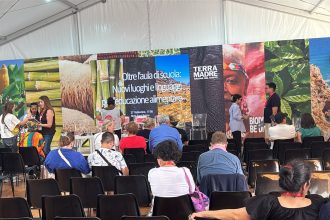
To better understand modern sugarcane farming practices, Japur was among the participants who attended the 3-day Sugar Industry Innovation Symposium and Expo 2024-Youth Edition held at a lakeside city hotel recently.
The over 2,800 participants were drawn from across the sugar industry, including 1,546 farmers, 12 exhibitors, and 22 international participants.
The Symposium’s theme “Youth Opportunities in the Sugar Value Chain,” was dedicated to empowering the youth to drive innovation, sustainability, and growth within the Kenyan sugar industry.
Sponsored by the EU, German Cooperation, Equity Bank and GIZ, the exhibition showcased innovative solutions in sustainable food, land and water systems geared towards transforming lives.
Delegates were also enlightened on new cane husbandry practices, cane varieties, cane maturity, post-harvesting practices, and weather and climatic conditions which affect the quality of cane.
A project undertaken by German Development Cooperation (GIZ) dubbed: “Soil Protection and Rehabilitation of Degraded Soils,” is aimed at enhancing Agri-Ecology services like food, fodder, energy, and fibre for human life in Western Kenya.
“We are concerned with how sugar is produced, traded and consumed. The food system in the country is unsustainable and there are mutual efforts from Kenya Sugar Board (KSB), and other stakeholders,” David Caston (GIZ) officer noted.
Caston pointed out that the project explores different approaches they apply, assess, and use to promote “ProSoil” thus providing a tangible knowledge foundation to assist decision-makers in developing adoption strategies for sustainable crop production.
A related book; “Protection and Rehabilitation of Degraded Soils in Western Kenya: Experiences from Two Decades of Research and Development,” explains that over-exploitation of land for ecosystem services and income generation has resulted in extensive land degradation, persistent degradation of biological productivity and ecological integrity, and loss of human value.
“Soils in the region have resulted in nutrient depletion and soil erosion leading to low and inadequate food supply and incomes on many smallholder farms. This has been exacerbated by climate change effects including unpredictable periods of drought and variable rainfall which is less frequent, reduced amounts but more in intensity,” the five co-authored book published on 15th March 2024 states.
Economically viable best practices for sustainable land use are well-known to farmers, but, are applied to a limited extent due to lack of socio-political goodwill.
Consequently, farmers lack incentives like secure land rights for agricultural enterprises to ensure that they sustainably utilize soil resources.
The majority of smallholder farmers have inadequate know-how to apply soil-friendly farming methods on their farms, or the money for initial investments.
The book further explains that a fifth of the world’s total land area is already degraded due to years of unsustainable land-use practices, land-use changes, and extreme weather events.
“Recent studies have indicated that more than half of all fertile soils in the world are now classified as highly degraded, with 25-40 billion tons lost annually.”
In Sub-Saharan Africa (SSA), land degradation is estimated to affect about 67 percent of the total area of the land (16.1 per square km) with varying degrees of severity.
The main direct drivers contributing to land degradation in SSA include unsustainable agricultural practices, over-grazing of livestock, and over-exploitation of forests and woodlands.
In addition, several waterways in SSA have been subject to significant pressure, particularly in the semi-arid and sub-humid zones where rivers are over-exploited and eutrophication is prevalent.
According to Shiferaw et al, poor water and land management in SSA is attributed to the increasing population growth coupled with poor or inadequate incentive structures for local resource managers, climate change and rampant poverty.
Similar studies undertaken in Kenya recently show that 12-15 percent of the country’s total land area, supporting 27 percent of its population, is suffering from severe to very severe degradation, with hotspots concentrated in the western and southern regions.
Western Kenya is one of the most densely populated and impoverished regions, with a population density rising to over 1,046 people per square km in Vihiga County which is above the national Kenyan average of 66 persons per Km2.
Land fragmentation and high population in the rural areas have rendered it unsustainable the traditional land management was based on fallowing unproductive fields to restore soil fertility.
This, however, has led to increased rates of soil erosion, landslides, soil nutrient loss, soil acidity and physical degradation with the consequences of low productivity in the region.
Tom Wafula,54, a sugarcane farmer from Kakamega County faces a similar soil and yields predicament just like his counterpart Japur.
“In the last 10 years, we have experienced downward loss in terms of quality and tonnage at the sugar companies weighbridge. In the last three days I have learnt a lot about the innovations to improve the soil and boost yields,” he said alongside the event.
“The rate of landscape degradation is increasing rapidly with soils lost on average 0.5 t ha-1 year-1 in 2017 compared to 0.3 t ha-1 in 1995. Physical mechanisms of soil degradation prevalent in the area include erosion by water; compaction; hard setting; surface sealing; crusting; and degradation of soil structure,” the book reads in part.
The leading chemical processes include soil nutrient loss; soil organic matter loss; soil acidification and dominant biotic processes such as pest infestations; changes in vegetation cover and composition (loss habit); changes in pollinator population and composition; and changes in soil biota.
Nature Education postulates that Soil Biota consists of micro-organisms (bacteria, fungi, archaea, and algae), soil animals (protozoa, nematodes, mites, springtails, spiders, insects, and earthworms) and plants (Soil Quality Institute 2001) living all or part of their lives in or on the soil or pedosphere.
Research studies show that soil acidity in the sugarcane region is due to monoculture coupled with the excessive use of chemical fertilizers. Agricultural liming is recommended though its application method is neither safe nor effective.
Another sticky issue faced by farmers like Japur and Wafula is nutrient mining due to continuous cultivation, insufficient nutrient supplementation about plant requirements, and high levels of erosion, leaching, and removal of crop residue from the fields.
A case in point is a fertile land that used to yield 2-4 t ha-1 cereal grains has become degraded, with cereal crop yields falling to less than one t ha-1.
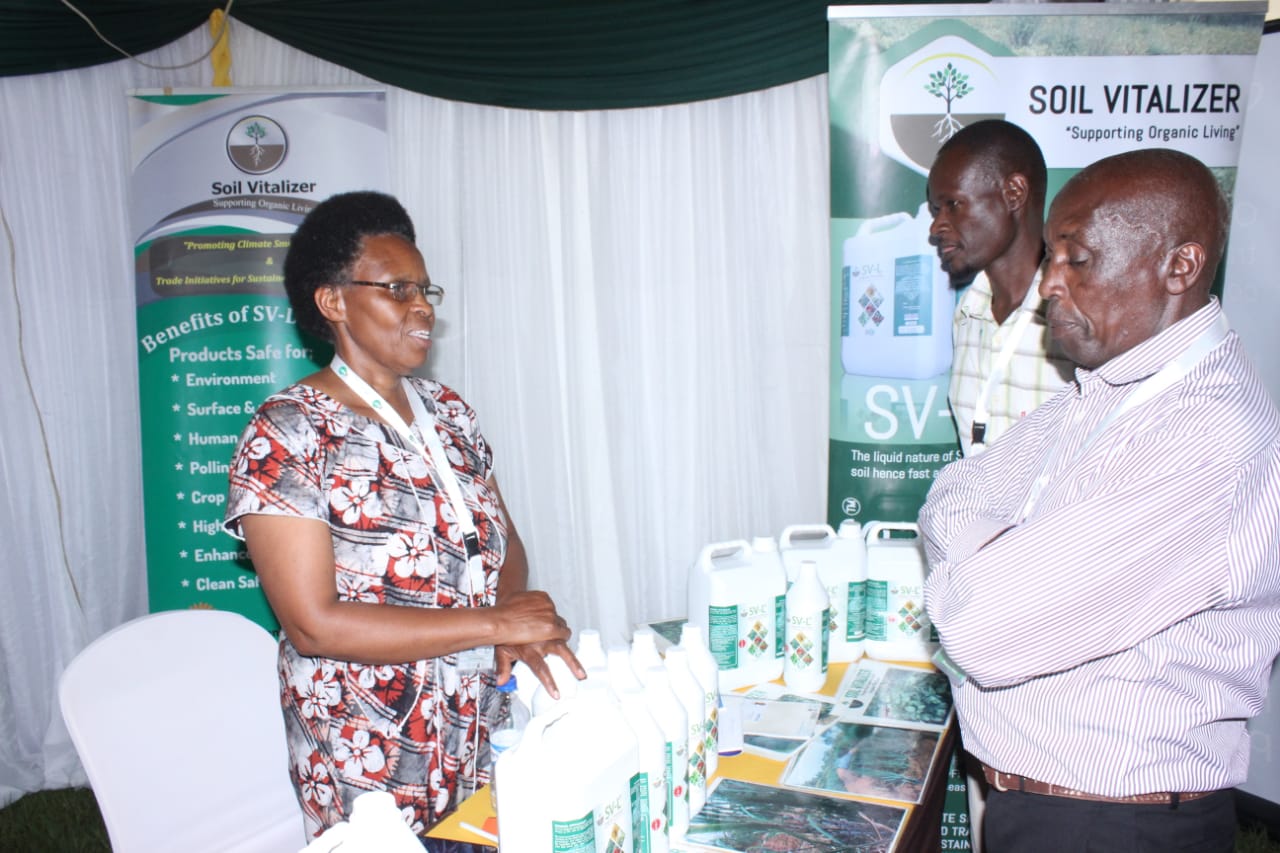
One of the exhibitors, Dr Reuben Nzuki, Director of Soil Vitalizer Limited stresses the urgent need by farmers to fully embrace the use of 100 percent organic fertilizers which are capable of restoring soils while boosting yields.
The researcher and business entrepreneur said that sugar production in Kenya has gone down due to destroyed soils by the overuse of synthetic fertilizer over prolonged periods.
“So many people have not ventured into organic farming and still use cow dung manure which is good. But the cow has already consumed some of the nutrients, so what you are applying on the shamba (farm) is a leftover,” said Dr Nzuki while speaking to this writer during the Expo.
In 2019 and highly motivated, he single-handedly started the SV-L (Liquid Organic Fertilizer) product which took him 3-years of research work to complete.
After testing and analysis in April, the Athi River-based firm scaled up the commercialization of their first product across the country based on demand in July 2023.
The all-in-one SV-L bottle is made from 100 per cent biodegradable materials which contain Macro (NPK) rich fertilizer, Top Dresser, Foliar and plenty of Micronutrients (trace) like (Fe, Ca, Mn, Mg, Cu, S, B, Mo, Zn) which are measured in Particles Per Million (PPM).
It costs Sh 1,500 for a litre and Sh 6,000 for 5 litres enough to grow one acre of whatever food crop through mixing and applying. He clarifies that in terms of the nutrients and crops for the ground, using a 4-litre of the dilute solution SV-L is enough when the soil is moist.
This product is ideal for all crops, flowers, lawns, kitchen gardens, and small and large farms. It revitalizes degraded soil, stabilizes soil pH, increases microbes’ activity, increases water retention, promotes crop resilience, increases crop production, improves crop shelf life and improves crop taste.”
Some of its readily available products in the market are SV-FP (Folia Pesticide) and SV-S (Solid Organic Fertilizer).
According to Dr Nzuki, the SV-FP is an all-in-one product specifically engineered to address bacteria, pests, fungi and adverse weather attacks.
The biological treatment properties are carried by a nutrient-rich mixture that provides plant needs as it has been treated from whatever pathogen has attacked it.
“They don’t have adverse effects on plants or humans, but four days’ withdrawal after application is needed before harvesting. The duration allows the plant to benefit from the treatment SV-P provides and helps to ensure the treatment material is not consumed by humans as it will have no direct benefit.”
On the other hand, SV-S are in either Granules or Pellets.
“Granules are convenient for machine application while pellets are for general hand application. It is helpful for dry time planting as it doesn’t scooch and can be planted together with seeds awaiting rainfall or watering,’’ Dr Nzuki said while adding that it doesn’t leach and remains in the soil for long.
He further tipped farmers that for perennial plants, the product is best applied twice a year before rainfall and flowering season.
“Basal fertilizer should be applied at planting or 14 days after seed emergence. Reapplication is recommended after 21 days after planting. The recommended method is Basal (Ensure quantifiable amount is applied on the base that rhymes the canopy of the crop), Drenching or Foliar Application.”
The importance of this method of applying fertilizer ensures that it is not washed away by running water.
He attributed cancer cases to the food we consume due to the heavy chemicals used in planting, and spraying which leads to the death of agronomics.
“Anybody who cares for their health will consider the organic solution. SVL is safe, healthy and friendlier to the body,” Dr Nzuki assures as he expounded on Supporting Organic Living.
To ensure a commitment to sustainable and environmentally friendly solutions that promote healthier plant growth and support organic living, the firm offers training and guidance to farmers on practical solutions to soil degradation and soil improvisation.
The SV-L product is patented (copyright), and they have received numerous requests from institutions like Kibos Sugar Millers and Kenya Sugar Research Foundation for joint research work on sugarcane for farmer’s benefit.
The Kenya Sugar Research Institute (SRI) continues to exert its efforts to develop demand-driven production technologies and innovations for sugarcane, related crops and their derivatives; the milling of such crops, and marketing of sugar and its co-products.
One of its key areas of focus has been the Crop Variety Development after the realization of cyclic and fluctuation in yields across the country.
According to SRI headquartered along Kisumu-Miwani road, the yields currently stand at 57 tons per ha against a potential of 100 tons per ha which hasn’t made it possible for farmers to break even.
The research body contends that most farmers have been unable to recoup the investments they put towards sugarcane farming. As an institution (breeders) we are challenged to develop varieties that will be able to increase productivity (yields and sucrose content) for the farmers and millers respectively.
Over the years, SRI has been able to develop 27 varieties with Early Maturation between 14-16 months depending on the altitude; and high yields of 100 tons per ha depending on the level of management.
Similarly, the variety is quite resilient in terms of disease and pest filtration and has been recommended to fit in specific sugarcane catchment areas.
In the Nyando Sugar Belt (Central Catchment Area), most farmers commonly grow the very-old CO617 variety that covers 83 percent of the catchment area.
The suitable varieties which can withstand stress, and waterlogging are CAN 95-378, CAN 95-593, CAN 97-317, CAN 98-530, CAN 98-551, CAN 00-3811, CAN 83-737, and CAN 82-808.
“These varieties have got high sucrose content of 12-15 percent as opposed to old commercial ones. CO617 has very high fibre which compromises the cane quality to less than 10 percent. The miller is not able to plough back his returns as they resort to diversification (bagasse for multiproduct) instead of sugar production.”
To benefit farmers like Japur and Wafula, the launch of the Kenya Sugar Industry Growers Guide during the symposium is a game changer as it seeks to position the country as a major sugar exporter regionally and globally.
Eng. Nicholas Gumbo, Chairman of Kenya Sugar Board said that the guide will aid in achieving the projected growth of one million metric tons from the current 700,000 metric tons with the hope of doubling it in the coming years.
“It will essentially help farmers maximize returns from the sugarcane supply by improving its quality and yield per acre. There will be a reduction in the cost of production and we will focus more on the sugarcane byproducts like biofuels, alcohol, spirits, bagasse to make briquettes and paper out of it,” Eng. Gumbo stressed while adding that it will help in building a climate-resilient economy to reduce the effects of Climate Change.
In concurrence, Jude Chesire, KSB’s Acting CEO remarked that sugarcane farmers will have strong authority to say what they want in the industry.
“We have the potential of producing 30 percent of sugar to enable us to be self-sufficient as a country. The guide focuses more on soil management and water conservation. The nutritional value will be added to the best practices on the result, money and the board,” said Chesire who doubles up as the Vice Chairman of the International Sugar Organization (ISO).
He lauded the new innovative technologies brought by the young people as they will go a long way in creating employment opportunities.
Other strategic partners who graced the expo were the Agricultural and Food Authority (AFA), the Kenya Agricultural and Livestock Research Organization (KALRO), iShamba and the national government.
To increase his farm yields, Japur and Wafula also learnt more about the Miwa Bora Mobile App that provides information and services related to the sugar Industry.
It is curated to help farmers, traders, millers, researchers, investors, extension workers, and other stakeholders in the sector to access and share information on best practices, new technologies, weather, market prices, and other relevant information.
Japur and Wafula decried that sugarcane farmers incur losses due to weighting, and longer delays in the cane payment system and appealed for the introduction of sugarcane bonuses like their coffee and tea counterparts.
To iron out shortcomings in payment which is largely based on weight irrespective of cane quality, KSB’s Guide book; “Quality Based Cane Payment System,” aims to provide a strong incentive for growers to maximize sugar content in cane and millers (processors) to maximize sugar recovery.
The system involves the allocation of industry revenue to support value-addition activities of growers, millers and marketers.
“It addresses declining productivity, concerns for sustainable development, equitable sharing of benefits, declining cane quality and factory performance, enable sharing of price and quality risks and benefits, adoption of improved varieties, farmer’s arrears, and lack of industry competitiveness.”
The majority of farmers appealed to both tiers of government to employ more Agricultural Extension Officers to visit farmers and impart more knowledge and skills on innovations to improve yields and cane quality.