YEREVAN and KAKAMEGA, Kenya — Inside the sprawling conference halls in Yerevan, diplomats in tailored suits debate clauses, definitions and compliance mechanisms at the seventeenth Conference of the Parties (COP17). Outside the negotiation rooms, digital monitors flash stark warnings about global ecosystem collapse. But thousands of miles southwest, in the lush, humid valleys of Kakamega County in western Kenya, the battle against extinction does not look like a policy draft. It looks like soil under fingernails, sun-cured indigenous seeds wrapped in cloth and women turning agricultural waste into smokeless fuel.
Here, rural communities are quietly pioneering nature-based climate solutions using generations of ancestral insight. Yet, as the world gathers in Armenia to review progress under the Kunming–Montreal Global Biodiversity Framework and mark the sixth meeting of parties to the Nagoya Protocol, their everyday stewardship raises an urgent ethical question: When local knowledge is studied, documented and transported into global corridors of science and policy, do its original authors retain a seat at the table?
The Hill That Community Built
Long before Misango Hills in Khwisero Sub-County attracted the attention of state agencies and university researchers, Sylvanus Omurunga remembers a hillside scarred by erosion and choked by invasive wild guava.
“We did not start with an international treaty or a budget,” Omurunga recalls, walking along the ridge that spans 256 acres (106 hectares). “We started as neighbours ,mothers, fathers and children just kneeling together around a small tree nursery.”
What began as community trust land evolved into a registered community forest association through sheer local sweat. Today, the revived canopy falls under the co-management framework of the Kenya Forest Service (KFS), attracting institutional interest and environmental research partners.
Yet Omurunga’s pride is tempered by an uncomfortable reality: researchers, students and conservation bodies regularly arrive to record the indigenous names, medicinal properties and ecological habits of the plants revived on these slopes. Once notebooks are filled and field samples collected, the trail frequently goes cold.
“We share this ancestral knowledge willingly because we want our environment restored,” Omurunga says quietly. “Yet indigenous and local communities remain the forgotten faces of conservation. We supply the data and preserve the ecosystems, but we are left without resources, never knowing where our knowledge goes or how it is credited.”
Between Reforestation and Biopiracy: The Nagoya Threshold
The gap between community goodwill and international governance is precisely what brings the story of Misango Hills to the debate tables of Yerevan. Under Articles 5(5) and 7 of the Nagoya Protocol which Kenya ratified in 2014 governments are legally obligated to ensure that traditional knowledge associated with genetic resources is accessed only with Prior Informed Consent (PIC) and under Mutually Agreed Terms (MAT) that ensure fair and equitable benefit-sharing.
The distinction is vital: planting samplings to restore a watershed is ecological management, not an automatic Access and Benefit-Sharing (ABS) trigger. But the moment an academic institution venture catalogs how a community utilizes a sacred shrub, herbal remedy or rare plant compound to extract active biochemical agents or develop commercial applications, the full weight of the Nagoya Protocol is engaged.
Asking what agreements exist at Misango Hills is not an accusation of misconduct. It is an inquiry into preventative justice. As Articles 6 and 7 of the Protocol stipulate, clear domestic contracts and transparent legal safeguards must be anchored before outside partnerships deepen, ensuring community members are recognized partners rather than uncompensated informants.
Antony Munanga, Director of Natural Resources in the Ministry of Environment, Water and Natural Resources for Kakamega County, confirms the long-standing community collaboration.
“We have partnered with the Misango Hills Forest Association since 2016,” Munanga says. “The landscape was severely degraded, overrun by wild guava scrub. Together, we established a structured work plan and mobilized public resources to restore the hill. Community participation has been central to that recovery.”
The institutional commitment is on record; the unresolved test is whether local custodians will have institutional standing if academic or scientific breakthroughs emerge from the ground they tended.
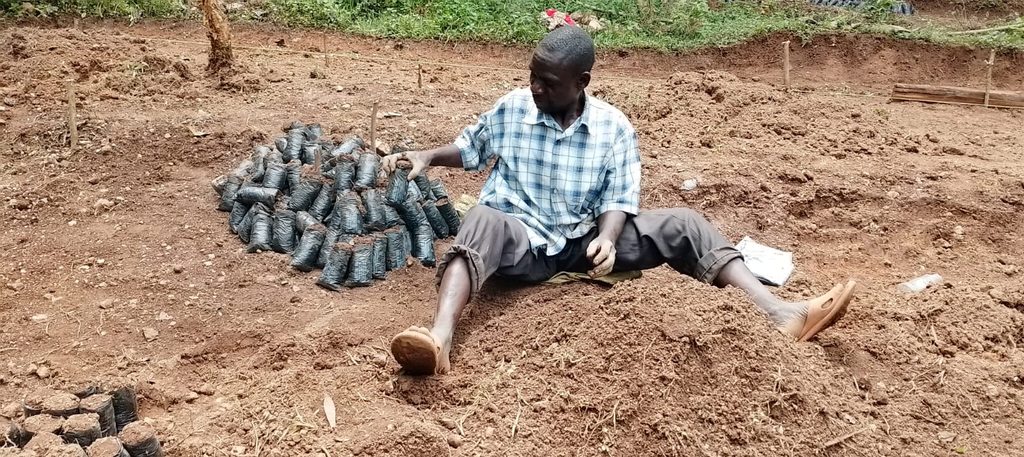
Misango Hills Association member filling soil in paper sleeves in preparation for the treeseedlings plantations
Seeds in Navakholo: Where Custom Meets Equity
Thirty kilometers North in Navakholo Sub-County, Petronilla Imbiakha, leader of the Munduma Seed Savers, holds a different treasury:Seeds passed down across generations.
For Imbiakha, safeguarding genetic heritage carries social friction that high-level biodiversity plenaries rarely capture. “When we began, women had no recognized rights to land,” she explains. “To protect our seeds, we had to deliberately bring men into the initiative, convincing them that preserving traditional crops meant family survival.”
Her work reveals why community consent cannot be treated as a rubber stamp. If outside agronomic institutions seek to collect or study indigenous seed varieties, an agreement struck with male elders or political gatekeepers can easily sideline the women whose labour preserved the crop diversity in the first place.
Articles 4 and 8 of the Nagoya Protocol recognize the specialized nature of agricultural biodiversity, yet international jargon often obscures the human reality: protecting plant genetic resources is meaningless if the women guarding the seed banks lack a decisive voice when external organizations request samples for institutional research.
The Boundary of Trust in Emusonga
In Emusonga village, Lurambi Sub-County, Florence Muketi leads the New Recada Women Group in turning char and agricultural refuse into clean-burning briquettes. It is a practical, community-led answer to indoor smoke pollution and illegal firewood cutting.
Muketi speaks transparently about her group’s process, the modest income keeping households and the raw organic materials they blend. Yet her openness illustrates another persistent vulnerability in nature-based development: the assumption that an interview, a field visit or a documented demonstration constitutes open-ended authorization.
Under Articles 2 and 3 of the Nagoya Protocol, briquette manufacturing falls outside biochemical utilization. But ethically, Muketi’s enterprise represents the same dilemma: local innovators frequently reveal their working methods to visitors without understanding who owns the intellectual rights to the resulting case studies, patents, or scaled enterprise models. Sharing a solution to inspire others should never mean surrendering sovereignty over it.
From Local Practice to the Yerevan Plenary
As delegates in Yerevan debate technical text for the six-year review of the Kunming Montreal Global Biodiversity Framework, experts warn that the gap between international policy and rural reality remains wide.
Dr. Davis Tarus, Program Manager at the African Agricultural Technology Foundation (AATF), argues that bridging this divide requires actionable empowerment. “We cannot speak about sustainable development without validating the foundation laid by smallholder farmers and rural communities,” Dr. Tarus notes. “Their local innovations are directly responsible for household food security across the continent. Recognition must go beyond praise; it must include equitable access to modern agricultural technologies, structured capacity building and genuine institutional support.”
Inside the negotiation corridors at COP17, Laipei Joseph of Kenya’s Indigenous Movement for Peace Advancement and Conflict Transformation (IMPACT) carries the message directly to global decision-makers.
“At IMPACT, our core mandate is ensuring that indigenous wisdom is systematically preserved through community-led research and knowledge management,” Joseph says. “Protecting this knowledge is not an academic exercise ,it directly preserves fragile ecosystems and cultural survival. Indigenous Peoples and Local Communities (IPLCs) are already on the front lines of conservation. Our rights, our ownership and our intellectual heritage must be formally safeguarded by the international treaties being negotiated here in Armenia.”
The Real Test of COP17
Back on the windswept ridge of Misango Hills, Sylvanus Omurunga watches the afternoon clouds roll over the canopy his neighbors planted tree by tree.
The diplomats gathering in Yerevan have committed themselves to curbing the planetary extinction crisis. Yet the legitimacy of any resolution passed in Armenia will not be measured by the eloquence of its preamble.
The real test lies in the dirt of Khwisero, Navakholo and Lurambi. It will be decided by whether the mothers who dry the seeds, the men who rebuild the hills and the youth who steward their sacred landscapes are treated as equal rights-holders possessing not just the burden of protecting nature, but the binding legal power to determine who studies it, who profits from it and who tells their story.
This story was produced as part of the 2026 CBD COP17 Fellowship, operated by Informed Earth in collaboration with Internews’ Earth Journalism Network.