By Irene Nasimiyu
When maize is going into the ground across Evuyeshere Village in Mumias West Sub- County in Kakamega County, Rose Kaunda is often doing the opposite.
She is planting sweet potatoes.
It is a farming decision that may appear simple, but it has become the foundation of the widow’s survival paying school fees for her children, putting food on the table and meeting daily household expenses since the death of her husband.
“When people are planting maize, I plant sweet potatoes,” Ms Kaunda says, standing among ridges carrying vines of different shades and shapes on her farm. “Then, when they are harvesting maize, there are usually few sweet potatoes in the market. That is when I get customers.”
Her farm is not just a field of vines. It is a living catalogue of sweet potato diversity: yellow-fleshed, orange-fleshed, white-fleshed and purple-fleshed varieties all planted in small quantities but with a big purpose.
For Ms Kaunda, every variety has its own market, use and story.
One reader who encountered her story earlier was surprised to learn that sweet potatoes have names and even joked that one variety, Irene, sounded like it had been named after the writer. The comment was humorous, but it revealed a serious gap: many consumers know sweet potatoes only by colour or taste, without appreciating the different varieties, their nutritional value and the opportunities they offer farmers.
Ms Kaunda is determined to change that understanding, one vine at a time.
“Sweet potatoes are not just sweet potatoes,” she says. “They have different names, colours, uses and benefits.”
A widow’s farm of many enterprises
Sweet potatoes are only one part of Ms Kaunda’s farm enterprise.She also keeps fish, rears bees, grows vegetables and cultivates maize. The different ventures help spread risk and ensure that if one crop fails or a market weakens, another activity can keep the household running.
“Farming does everything for me,” she says. “It pays school fees for my children and takes care of daily spending.”
But sweet potatoes occupy a special place because they mature relatively quickly, can be harvested in stages and can be processed into a range of products.
Ms Kaunda gets her planting vines from the Kenya Agricultural and Livestock Research Organisation (KALRO), where improved varieties are developed and distributed to farmers.She says the most important lesson she has learnt is not to put all her hopes in one variety.
“I plant all the varieties in small quantities,” she says. “Different customers want different types. Some want the sweet ones for boiling, others want orange-fleshed sweet potatoes for juice or crisps and others prefer purple ones.”
The sweet yellow Namunyekera
Among the varieties on her farm is a yellow-fleshed sweet potato known locally as Namunyekera, a Luhya name. Some people see it as white skinned and creamed inside.It is popular among many consumers because of its sweet taste and firm texture when cooked.
“People love Namunyekera because it is sweet and hard in texture,” Ms Kaunda says.
For families looking for a filling, familiar sweet potato to boil and eat with tea or as a meal accompaniment, the yellow-fleshed variety is a favourite.
Its popularity demonstrates that consumer preference is not driven by colour alone. Texture, sweetness, cooking time and local food traditions all shape demand.
Orange-fleshed varieties: Kabode and Irene
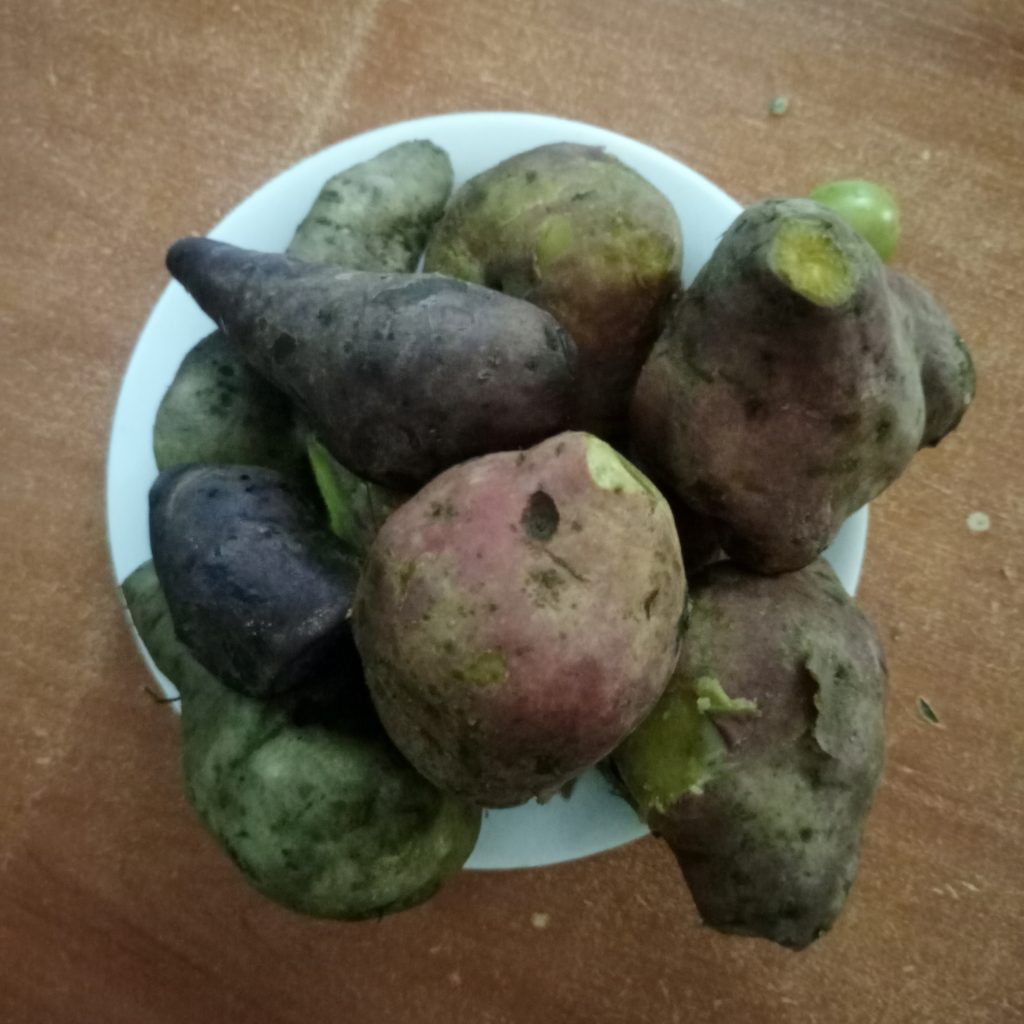
Then there are the orange-fleshed sweet potatoes, including Kabode and Irene.These varieties may not be the first choice for some households that prefer boiled sweet potatoes with a firmer texture, but Ms Kaunda says their real value lies in their nutritional content and processing potential.
“Some people do not like boiling Kabode and Irene,” she says. “But they have good nutrients for the human body.”
Orange-fleshed sweet potatoes are widely valued for their high levels of beta-carotene, which the body converts into vitamin A. Vitamin A supports normal vision, immunity and healthy growth especially among children.On her farm, Kabode and Irene are turned into more than a boiled snack.
Ms Kaunda processes them into sweet potato juice, wine, crisps and flour. She also mixes sweet potato materials with soya beans to make poultry feed.
The products are an example of how value addition can transform a crop that is often treated as a subsistence food into a source of income.
Yet processing remains labour intensive.
Making crisps, for example, takes time because Ms Kaunda does not have a slicing machine. She uses a knife to cut the sweet potatoes into pieces, slowing production when demand rises.
“When clients need more crisps, it becomes difficult because I do not have a machine,” she says. “Using a knife takes a lot of time.”
Purple sweet potatoes that resemble arrowroots
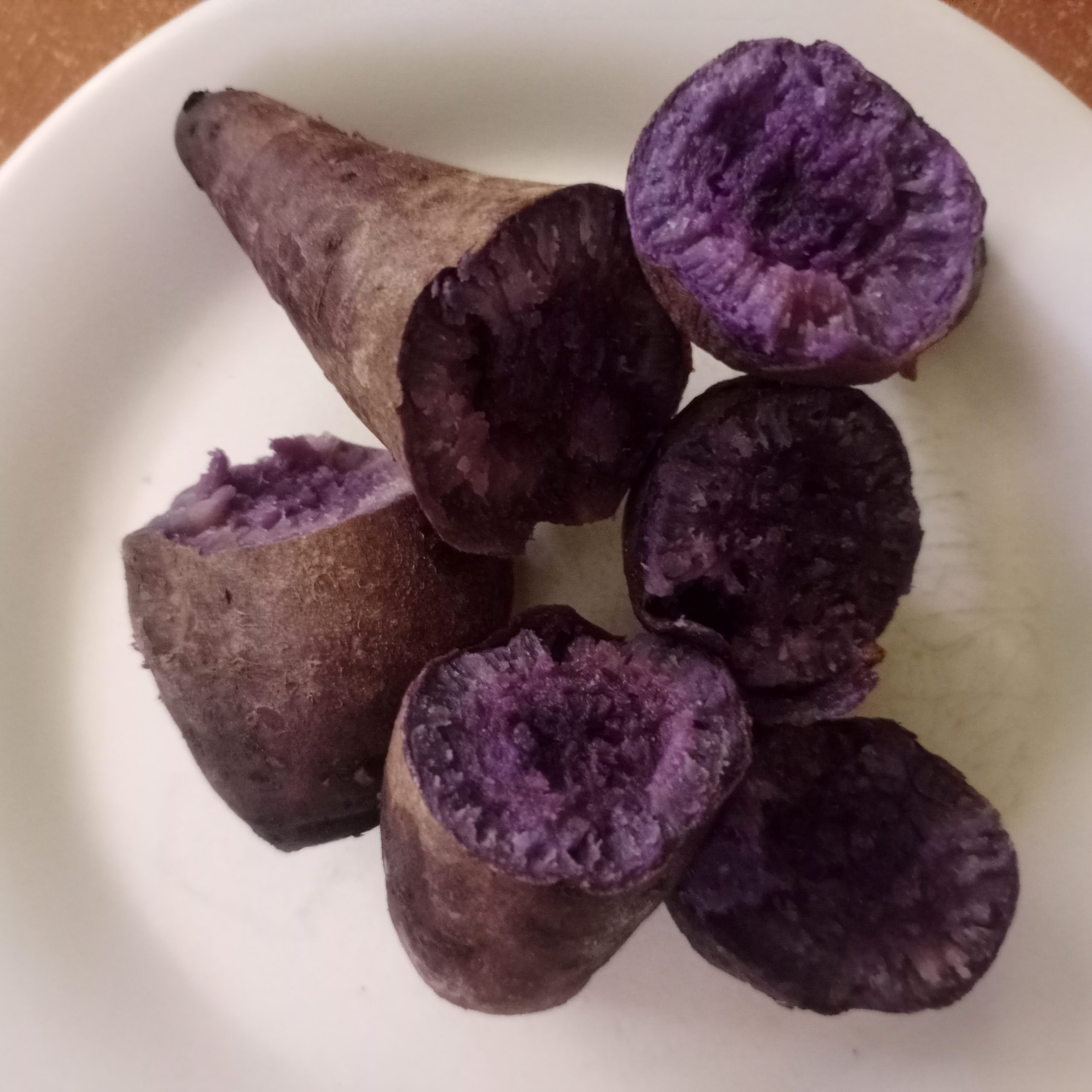
The purple-fleshed varieties are perhaps the most striking on Ms Kaunda’s farm.
Their deep colour and appearance make them resemble arrowroots. While some consumers are hesitant to boil them, Ms Kaunda says they are increasingly suitable for processing into crisps and sweet potato flour.
“People do not like boiling them as much, but they are good for crisps and flour,” she says. “Some local people still enjoy them boiled.”
Purple-fleshed sweet potatoes contain natural pigments known as anthocyanins, the same compounds that give other purple and blue foods their distinctive colours. Nutrition experts often encourage consumers to include a variety of naturally coloured foods in their diets because diversity helps broaden nutrient intake.
Ms Kaunda also uses sweet potato leaves as vegetables.
“The leaves can be cooked as vegetables just like cowpeas vegetables,” she says, adding that local communities value them as a nutritious food, especially for people seeking iron-rich green vegetables.
Health professionals caution, however, that sweet potato leaves and other indigenous vegetables should complement not replace professional medical care for conditions such as anaemia.
White-fleshed varieties: simple, sweet and familiar
The white-fleshed remain a household favourite. The local name is Mugande
They can be eaten raw or boiled, and are known for their sweetness. Their skin may appear red or yellow on the outside, but the inside remains white.
“These ones are sweet for eating,” Ms Kaunda says. “You can eat them raw or boiled.”
For many families, white-fleshed sweet potatoes carry familiarity. A quick breakfast, a snack for children walking to school or a filling meal on days when maize flour is scarce.
But Ms Kaunda’s farm shows that familiarity should not mean limiting consumers to a single type.
“If people know the different varieties, they can choose depending on what they want. Food, nutrition or processing,” she says.
Farming against the seasons
Ms Kaunda’s success is not accidental. It comes from carefully observing seasons, market shortages and consumer demand.
By planting when many farmers are concentrating on maize, she positions herself to supply sweet potatoes when they are scarce.
It is a strategy that gives her a market advantage, but it also exposes her to risk.
Selecting good vines is one of the biggest challenges.
“Getting good vines for planting can sometimes be difficult,” she says. “If the vines are not good, you cannot expect a good harvest.”
Changing weather patterns have also made farming unpredictable. Too much rain can damage crops, while prolonged dry spells can reduce yields and affect the quality of roots.
“Sometimes there is too much rain, and sometimes there is little rain,” she says. “Both can affect sweet potatoes.”
For commercial production, Ms Kaunda sometimes leases land. But land leasing comes with its own uncertainty. A land owner may demand to take back the land or harvest the crop before the sweet potatoes are mature, putting the farmer’s investment at risk.
The missing machines
Technology is another challenge.
Ms Kaunda says her juice business needs proper storage. Without a fridge, she cannot preserve juice for long periods, limiting the volume she can make and sell.
A blender would also make processing easier, while a crisp cutting machine would reduce the hours spent slicing roots by hand.
“In the village, you have to keep looking for your market,” she says. “But when you get customers, you also need equipment to meet their demand.”
Her experience captures a wider challenge facing many small-scale farmers. They may have the knowledge, land and market ideas but lack the equipment needed to move from small production to a stable agribusiness.
Professor of Agriculture and Dean at Masinde Muliro University of Science and Technology Vitalis Ogema says farmers such as Ms Kaunda need practical support beyond seeds and training.
He says small-scale farmers need access to appropriate machines, technical knowledge and reliable market connections so that they can add value to crops and earn more from their labour.
Emmanuel Kariuki serves as County Chief Officer for Agriculture in Kakamega County. He says the county is putting in place mechanisms to support farmers, particularly in the face of climate change and growing food-security concerns.
He adds that agriculture remains the backbone of the country’s economy and that supporting farmers with climate-smart production, value-addition equipment and market linkages is essential. He further says that they have collaborated with other partners like to ensure that women and communities thrive in different ventures.
Why KALRO encourages sweet potato farming
Shadrack Odikara Oriama is a Scientist at Kenya Agricultural and Livestock Research Organisation (KALRO),he letariat that sweet potatoes offer farmers an important opportunity because they are adaptable, nutritious and suitable for both household consumption and business.
The officer says farmers should plant clean and quality vines from recognised sources to reduce disease risk and improve yields. The officer further notes that orange-fleshed sweet potatoes can help improve diets because of their vitamin A content, while diverse varieties give farmers more options for selling fresh roots and processed products.
The KALRO officer adds that farmers should select varieties based on their agro-ecological conditions, market demand and intended use whether boiling, baking, making flour and producing crisps or processing juice.
Indigenous foods for health
“Foods such as sweet potatoes deserve a central place on Kenyan plates because they are locally available, affordable and nutritionally valuable.” Says Milka Onzere a nutritionist in Kakamega County.
The nutritionist says indigenous and locally grown foods can provide energy, fibre, vitamins and minerals, while orange-fleshed sweet potatoes are especially important as a source of beta-carotene. The expert advises families to eat a variety of foods including different-coloured sweet potatoes, vegetables, legumes and protein foods rather than relying on one staple.
She urges households to avoid dismissing indigenous foods as poor people’s food, saying they can play an important role in improving diets, especially for children, pregnant women and older people.
For Ms Kaunda, however, the value of sweet potatoes is not only measured in vitamins, colour and market price.
It is measured in school fees paid on time. In meals placed before her children. In the confidence of a widow who has built a livelihood from a crop many people still underestimate.
Her field in Evuyeshere Village is proof that beneath every sweet potato vine lies more than a root.
There is a strategy. There is resilience. And, as one curious reader discovered, there is a name.